Good to know
What is included in a storm damage roof repair visit?
A storm damage roof repair visit usually begins with a ground-level look at the property and then a roof inspection slope by slope. The provider checks shingle surfaces for bruising, cracked or missing granules, lifted tabs and exposed mat, then moves to the areas where wind and hail tend to show damage first, including ridge caps, soft metals, flashing and roof penetrations.
The visit also covers the attic. Water from a storm can travel along decking and framing before it shows on a ceiling, so the inspector looks for wet insulation, dark staining on the underside of the deck and daylight around vent or pipe openings. Photos and notes are taken during the visit so the scope of repair is tied to what was observed rather than a general impression.
A visit can also include a written summary of the damaged areas, the repair steps recommended and whether any part of the work needs a permit. Your provider can then explain the options for repairing the affected section or, where the damage is widespread, discuss replacement. Because the pros we connect you with are independent local providers, the exact scope of each visit can vary with the provider and the condition of the roof.
Which sub-services are part of storm damage roof repair?
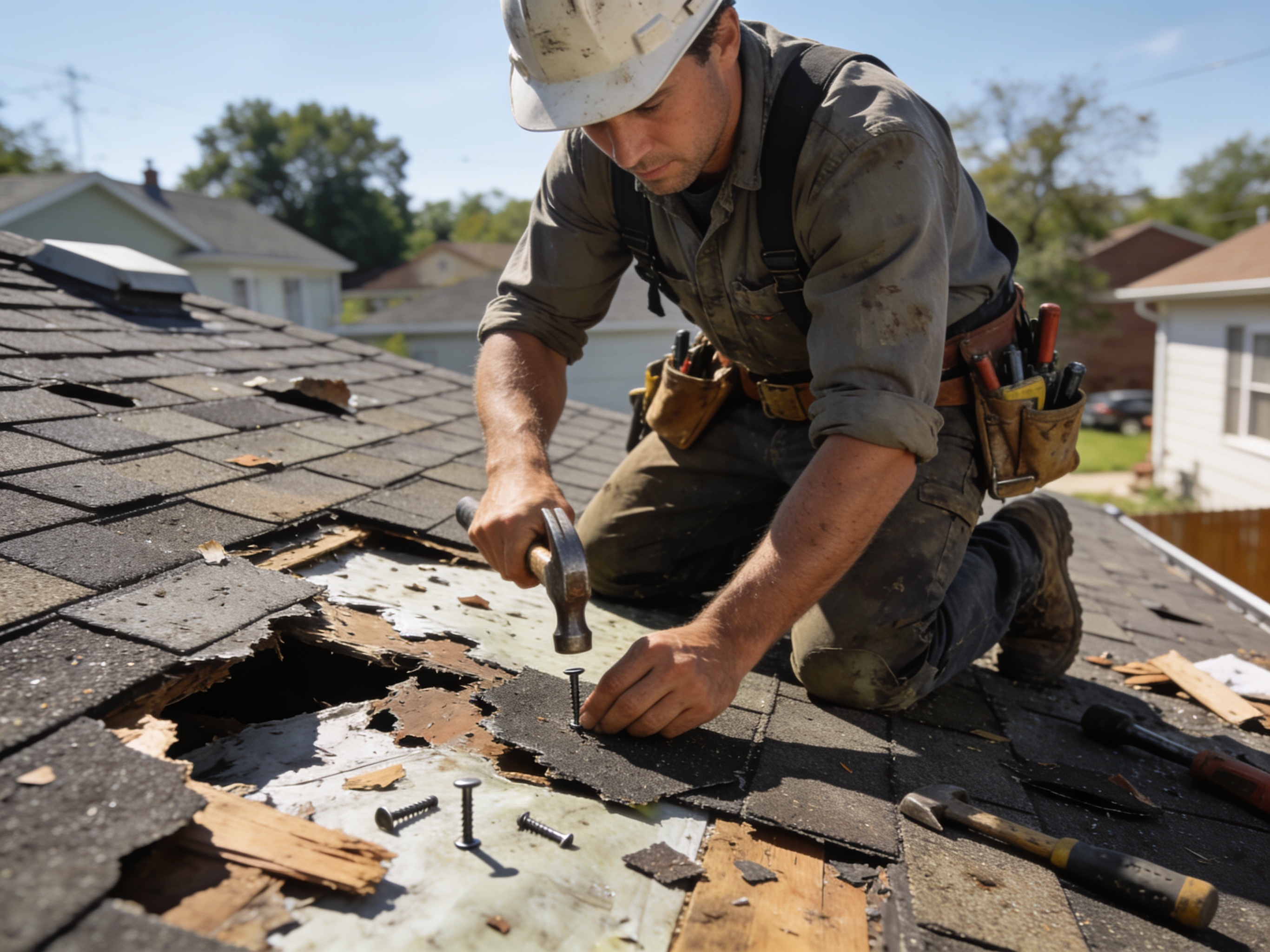
Storm damage work is rarely a single task. Common sub-services include replacing individual architectural shingles that are cracked or missing, resealing or replacing lifted shingle tabs, repairing or replacing damaged flashing around chimneys, skylights and wall intersections, and replacing pipe boots that have split under hail or wind.
Other sub-services protect the parts of the roof that keep water away from the decking. Valleys, ridge vents and drip edge are checked after a storm because damage in those areas can let water reach the underlayment and decking. Where the decking is soft or rotted, the provider may recommend replacing those sections. Metal roofing systems, which are also found in the area, need their own inspection of panel seams, fasteners and trim.
Some properties need a broader scope. When hail has damaged most of the slopes on a roof, the provider may discuss full replacement rather than a series of spot repairs. Gutter and downspout repair, soffit and fascia work and attic ventilation fixes are sometimes listed alongside roof work, so ask your provider to explain which items belong to the roof scope and which are separate.
How can I tell if hail damaged my roof?
Hail damage is often hard to see from the street. Look for dents or soft spots on metal vents, gutters, downspouts and roof-mounted equipment, and for shingles with cracked or bruised surfaces, exposed mat, or granules collecting in gutters and at downspout outlets. Spatter marks can look similar to damage on a shingle, so an inspector checks the surface texture and whether the shingle still sheds water properly.
Hail size matters. NOAA-recorded hail of 1 inch or larger occurred near Round Rock on 9 days from 2016 to 2025, and the largest hail since 1996 was 4.00 in on September 24, 2023. Hail of that size can dent or crack shingles and damage soft metals, so a roof in this area should be checked after any strong storm, even if the inside of the house looks dry.
A practical first step is to document what you can see safely from the ground. Take dated photos of the house from several sides, the gutters and downspouts, the yard around the house and any dented equipment. Do not climb onto the roof to take these photos. Share the photos with your provider and with your insurer when you begin a claim, and keep the records together in one folder.
Because storm damage can be uneven across slopes, a provider inspects each slope separately before recommending a repair scope. This slope-by-slope check helps separate damage caused by the storm from wear that was already present, which matters both for the repair and for the paperwork.
Does Round Rock require a permit for storm roof repair?
The City of Round Rock does not require a building permit for residential re-roofing. Roof modifications beyond replacing the existing roofing materials require a Residential Remodel Permit, so the answer depends on how much of the roof is being changed.
Drip edge is a common point of confusion. The city requires drip edge installation in accordance with IRC Section R905.2.8.5, so any repair that involves replacing edge metal should follow that requirement. Structural modifications require an engineered design under the city's residential remodel guidance, which becomes relevant when repairs go beyond surface replacement and reach decking or framing.
Properties with Historic Overlay zoning are reported by a local roofing source to need a Certificate of Appropriateness before alterations. Verify this with the City of Round Rock Building Inspection Division before relying on it, because zoning status is specific to each property. The provider you are matched with can explain which permit path applies to the scope they recommend.
Why does storm season affect when repairs should happen?
The City of Round Rock notes that the busiest period for severe thunderstorms and tornadoes generally runs from March through June. NOAA records summarised for Round Rock report 61 hail days within 15 miles of the city center since 2010, and April has the most hail days. That concentration means a roof can take several impacts in one season, and a small opening can grow when the next storm arrives.
Timing matters for the repair itself. When water is actively entering, the first step is stabilising the area, usually with a secured tarp over the compromised section. The permanent repair is then scheduled for a dry window, when shingles, sealant and flashing can be installed and bonded properly. A tarp is a temporary measure rather than a finished repair, and it should be checked after every storm until the permanent work is done.
The March 21, 2022 tornado shows how quickly damage can occur. The Round Rock/Granger tornado touched down southwest of the I-35/TX 45 interchange, reached EF2 strength and tore roofs off several residences in the Windy Terrace and Greenlawn Place neighborhoods. Not every storm is that severe, but it is a reminder to inspect the roof after any significant event.
Which Round Rock neighborhoods have older roofs most likely to leak?
Roof age is one factor in how storm damage shows up, and build era varies across the city. Interstate 35 splits Round Rock: the west side is more established, with homes mostly built in the 1980s through the 2000s, while the east side holds most of the new construction. ACS 2020-2024 figures for Round Rock list 51,143 housing units and a median year structure built of 2002.
Neighborhood build eras give a rough guide. Cat Hollow homes were mostly built 1991-2001, Brushy Creek homes 1978-2005, and Forest Creek was built mostly between 1995 and 2005. Teravista homes date from the 2000s and early 2010s, Behrens Ranch is a 2000s-to-early-2010s community, and Paloma Lake was developed between 2009 and 2020, with most homes from the 2010s.
Build era does not tell you whether a specific roof is leaking. Older roofs may have shingles near the end of their service life, while newer roofs can still take hail damage. Other areas, including Round Rock West, Stone Canyon, Old Town Round Rock and Avery Centre, should be judged on each roof's own condition. Owner-occupied housing units made up 55.5% of Round Rock homes for 2020-2024, so many repair decisions rest directly with the homeowner.
Still have questions? Talking it through first is fine.